The Laplace Equation
Laplace's Equation in Spherical Coordinates
Many important electrostatic problems possess spherical symmetry, making spherical coordinates the natural choice. In spherical coordinates, \( (r,\theta,\phi) \), Laplace's equation takes the form
$$ \nabla^2 V = \frac{1}{r^2} \frac{\partial}{\partial r} \left( r^2 \frac{\partial V}{\partial r} \right) + \frac{1}{r^2\sin\theta} \frac{\partial}{\partial \theta} \left( \sin\theta \frac{\partial V}{\partial \theta} \right) + \frac{1}{r^2\sin^2\theta} \frac{\partial^2V}{\partial \phi^2} $$We will focus on azimuthally symmetric systems, where the potential is independent of \( \phi \):
$$ \frac{\partial V}{\partial \phi}=0 $$In this case, Laplace's equation reduces to
$$ \frac{\partial}{\partial r} \left( r^2 \frac{\partial V}{\partial r} \right) + \frac{1}{\sin\theta} \frac{\partial}{\partial \theta} \left( \sin\theta \frac{\partial V}{\partial \theta} \right) = 0 $$We again use separation of variables and look for solutions of the form
$$ V(r,\theta) = R(r) \Theta(\theta) $$Substituting into Laplace's equation gives
$$ \Theta \frac{d}{dr} \left( r^2 \frac{dR}{dr} \right) + R \frac{1}{\sin\theta} \frac{d}{d\theta} \left( \sin\theta \frac{d\Theta}{d\theta} \right) = 0 $$Dividing by \(R \Theta\) gives
$$ \frac{1}{R} \frac{d}{dr} \left( r^2 \frac{dR}{dr} \right) + \frac{1}{\Theta\sin\theta} \frac{d}{d\theta} \left( \sin\theta \frac{d\Theta}{d\theta} \right) = 0 $$Rearranging,
$$ \frac{1}{R} \frac{d}{dr} \left( r^2 \frac{dR}{dr} \right) = - \frac{1}{\Theta\sin\theta} \frac{d}{d\theta} \left( \sin\theta \frac{d\Theta}{d\theta} \right) $$The left-hand side depends only on \(r\), while the right-hand side depends only on \(\theta\). Therefore both sides must equal a constant:
$$ \frac{1}{R} \frac{d}{dr} \left( r^2 \frac{dR}{dr} \right) = \lambda $$ $$ \frac{1}{\Theta\sin\theta} \frac{d}{d\theta} \left( \sin\theta \frac{d\Theta}{d\theta} \right) = - \lambda $$This produces the radial and angular equations:
$$ \frac{d}{dr} \left( r^2 \frac{dR}{dr} \right) - \lambda R = 0 $$ $$ \frac{1}{\sin\theta} \frac{d}{d\theta} \left( \sin\theta \frac{d\Theta}{d\theta} \right) + \lambda\Theta = 0 $$The Angular Equation
To simplify the angular equation, define
$$ x=\cos\theta $$Since
$$ \frac{dx}{d\theta} = -\sin\theta $$derivatives with respect to \( \theta \) can be rewritten in terms of \(x\). After some algebra, the angular equation becomes
$$ \frac{d}{dx} \left( (1-x^2) \frac{d\Theta}{dx} \right) + \lambda\Theta = 0 $$or equivalently,
$$ (1-x^2) \frac{d^2\Theta}{dx^2} - 2x \frac{d\Theta}{dx} + \lambda\Theta = 0 $$This is Legendre's differential equation.
Regular solutions on the interval \( -1 \le x \le 1 \) exist only for
$$ \lambda=\ell(\ell+1), \qquad \ell=0,1,2,\dots $$The corresponding solutions are the Legendre polynomials, \( P_\ell(x) \). Therefore
$$ \Theta_\ell(\theta) = P_\ell(\cos\theta) $$The first few Legendre polynomials are
$$ P_0(x)=1 $$ $$ P_1(x)=x $$ $$ P_2(x)=\frac12(3x^2-1) $$ $$ P_3(x)=\frac12(5x^3-3x) $$The Legendre polynomials can be generated using Rodrigues' formula:
$$ P_\ell(x) = \frac{1}{2^\ell \ell!} \frac{d^\ell}{dx^\ell} (x^2-1)^\ell $$This gives a compact way to construct each polynomial \( P_\ell(x) \) directly.
These functions form an orthogonal basis on the interval \( [-1,1] \):
$$ \int_{-1}^{1} P_\ell(x)P_m(x)\,dx = 0, \qquad \ell\ne m $$Orthogonality allows arbitrary angular boundary data to be expanded as a series of Legendre polynomials.
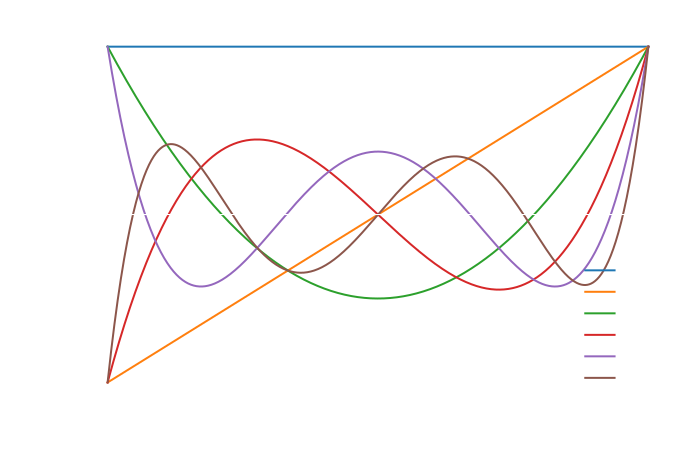
Several Legendre polynomials are plotted below. Higher-order polynomials exhibit increasingly complex oscillatory structure while remaining orthogonal on the interval \( -1 \le x \le 1 \). This orthogonality makes them particularly useful for expanding angular functions in spherical geometries.
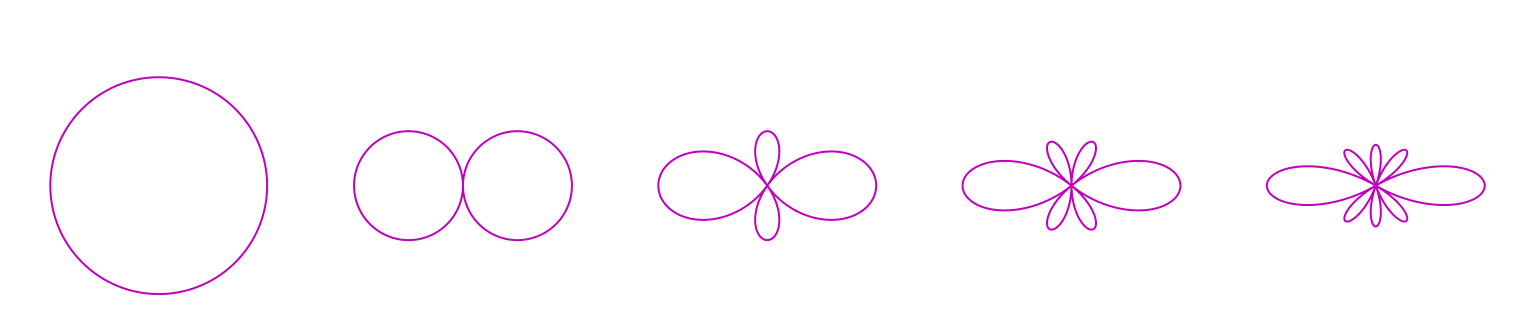
The angular dependence of many spherically symmetric boundary-value problems is described by \( P_\ell(\cos\theta) \). The polar plots below illustrate the angular patterns associated with several values of \( \ell \). Higher-order modes contain additional angular nodes, producing increasingly intricate directional structure.
 See plot code
The Radial Equation
The radial equation becomes
$$ \frac{d}{dr} \left( r^2 \frac{dR}{dr} \right) - \ell(\ell+1)R = 0 $$Expanding the derivative gives
$$ r^2R'' + 2rR' - \ell(\ell+1)R = 0 $$We look for power-law solutions of the form
$$ R(r)=r^\alpha $$Then
$$ R'(r)=\alpha r^{\alpha-1} $$ $$ R''(r)=\alpha (\alpha-1) r^{\alpha-2} $$Substituting into the radial equation gives
$$ \alpha(\alpha-1)r^\alpha + 2\alpha r^\alpha - \ell(\ell+1)r^\alpha = 0 $$Hence
$$ \alpha^2+\alpha-\ell(\ell+1)=0 $$Solving this quadratic equation gives
$$ \alpha=\ell $$ $$ \alpha=-(\ell+1) $$Therefore the radial solutions are
$$ R_\ell(r) = A_\ell r^\ell + \frac{B_\ell}{r^{\ell+1}} $$Combining the radial and angular parts gives the general azimuthally symmetric solution:
$$ V_\ell(r,\theta) = \left( A_\ell r^\ell + \frac{B_\ell}{r^{\ell+1}} \right) P_\ell(\cos\theta) $$ $$ V(r,\theta) = \sum_{\ell=0}^{\infty} \left( A_\ell r^\ell + \frac{B_\ell}{r^{\ell+1}} \right) P_\ell(\cos\theta) $$The coefficients are determined by the boundary conditions and by physical requirements such as regularity at the origin or decay at infinity.
For example:
- Inside a finite region containing the origin, the terms \( r^{-(\ell+1)} \) are discarded because they diverge at \( r=0 \).
- Outside a localized charge distribution, the terms \( r^\ell \) are discarded because they diverge as \( r\rightarrow\infty \).
Each term in the series corresponds to a different angular structure, or multipole moment:
$$ \ell=0 \quad \text{monopole} $$ $$ \ell=1 \quad \text{dipole} $$ $$ \ell=2 \quad \text{quadrupole} $$and so on.
The Legendre-polynomial expansion therefore provides a natural way to describe how electrostatic potentials vary both radially and angularly in spherically symmetric geometries.
eg. The potential \( \color{#00f0ff} V_0(\theta) \) is specified on the surface of a hollow sphere of radius \( \color{#00f0ff} R \). Find \( \color{#00f0ff} V \) inside the sphere.
In this case \( B_\ell = 0 \) for all \( \ell \), otherwise \( V \) would blow up at \( r=0 \)
$$ V(r,\theta) = \sum_{\ell=0}^{\infty} A_\ell r^\ell P_\ell(\cos\theta) $$ $$ V(R,\theta) = \sum_{\ell=0}^{\infty} A_\ell R^\ell P_\ell(\cos\theta) = V_0(\theta) $$\( P_\ell(x) \) constitute a complete set of functions on the interval \( -1 \le x \le 1 \) (\( 0 \le \theta \le \pi \)). They are also orthogonal functions.
$$ \left\langle P_\ell, P_{\ell'} \right\rangle = \displaystyle \int_{-1}^{1} P_\ell(x)P_{\ell'}(x)\,dx = \frac{2}{2\ell+1}\delta_{\ell\ell'} $$ $$ dx = d(\cos\theta) = -\sin\theta\,d\theta \quad \cos^{-1}(-1)=\pi \quad \cos^{-1}(1)=0 $$ $$ \therefore \int_0^\pi P_\ell(\cos\theta) P_{\ell'}(\cos\theta) \sin\theta\,d\theta = \begin{cases} \dfrac{2}{2\ell+1} & \ell'=\ell \\[0.4em] \quad \; \, 0 & \ell'\ne\ell \end{cases} $$ $$ \sum_{\ell=0}^{\infty} A_\ell R^\ell \int_0^\pi P_\ell(\cos\theta) P_{\ell'}(\cos\theta) \sin\theta\,d\theta = \int_0^\pi V_0(\theta) P_{\ell'}(\cos\theta) \sin\theta\,d\theta $$ $$ A_{\ell'}R^{\ell'} \frac{2}{2\ell'+1} = \int_0^\pi V_0(\theta) P_{\ell'}(\cos\theta) \sin\theta\,d\theta $$ $$ \therefore \, A_\ell = \frac{2\ell+1}{2R^\ell} \int_0^\pi V_0(\theta) P_\ell(\cos\theta) \sin\theta\,d\theta $$Suppose \( \color{#00f0ff} \displaystyle V_0(\theta)=k\sin^2\left(\frac{\theta}{2}\right) \)
$$ V_0(\theta) = k\sin^2\left(\frac{\theta}{2}\right) = \frac{k}{2}(1-\cos\theta) \quad \text{as} \; \cos2x = 1-2\sin^2x $$ $$ \therefore \, V_0(\theta) = \frac{k}{2} \left( P_0(\cos\theta)-P_1(\cos\theta) \right) $$ $$ V(R,\theta) = \sum_{\ell=0}^{\infty} A_\ell R^\ell P_\ell(\cos\theta) = \frac{k}{2} \left( P_0(\cos\theta)-P_1(\cos\theta) \right) $$ $$ \Rightarrow \; A_0=\frac{k}{2}, \qquad A_1=-\frac{k}{2R} $$ $$ V(r,\theta) = \frac{k}{2} \left( r^0P_0(\cos\theta) - \frac{r}{R}P_1(\cos\theta) \right) $$ $$ \therefore \, V(r,\theta) = \frac{k}{2} \left( 1-\frac{r}{R}\cos\theta \right) $$What is \( \color{#00f0ff} V \) outside the sphere, assuming there's no charge there?
In this case \( A_\ell = 0 \) for all \( \ell \), or else \( V \) would not go to zero at \( \infty \)
$$ V(r,\theta) = \sum_{\ell=0}^{\infty} \frac{B_\ell}{r^{\ell+1}} P_\ell(\cos\theta) $$ $$ V(R,\theta) = \sum_{\ell=0}^{\infty} \frac{B_\ell}{R^{\ell+1}} P_\ell(\cos\theta) = V_0(\theta) $$ $$ \Rightarrow \; \frac{B_{\ell'}}{R^{\ell'+1}} \frac{2}{2\ell'+1} = \int_0^\pi V_0(\theta) P_{\ell'}(\cos\theta) \sin\theta\,d\theta $$ $$ \therefore \, B_\ell = \frac{2\ell+1}{2} R^{\ell+1} \int_0^\pi V_0(\theta) P_\ell(\cos\theta) \sin\theta\,d\theta $$eg. An uncharged metal sphere of radius \( \color{#00f0ff} R \) is placed in an otherwise uniform electric field \( \color{#00f0ff} \vec{E} = E_0\hat{z} \). The field will push positive charge to the northern surface of the sphere, and symmetrically negative charge to the southern surface. This induced charge, in turn, distorts the field in the neighbourhood of the sphere. Find \( \color{#00f0ff} V \) in the region outside the sphere.
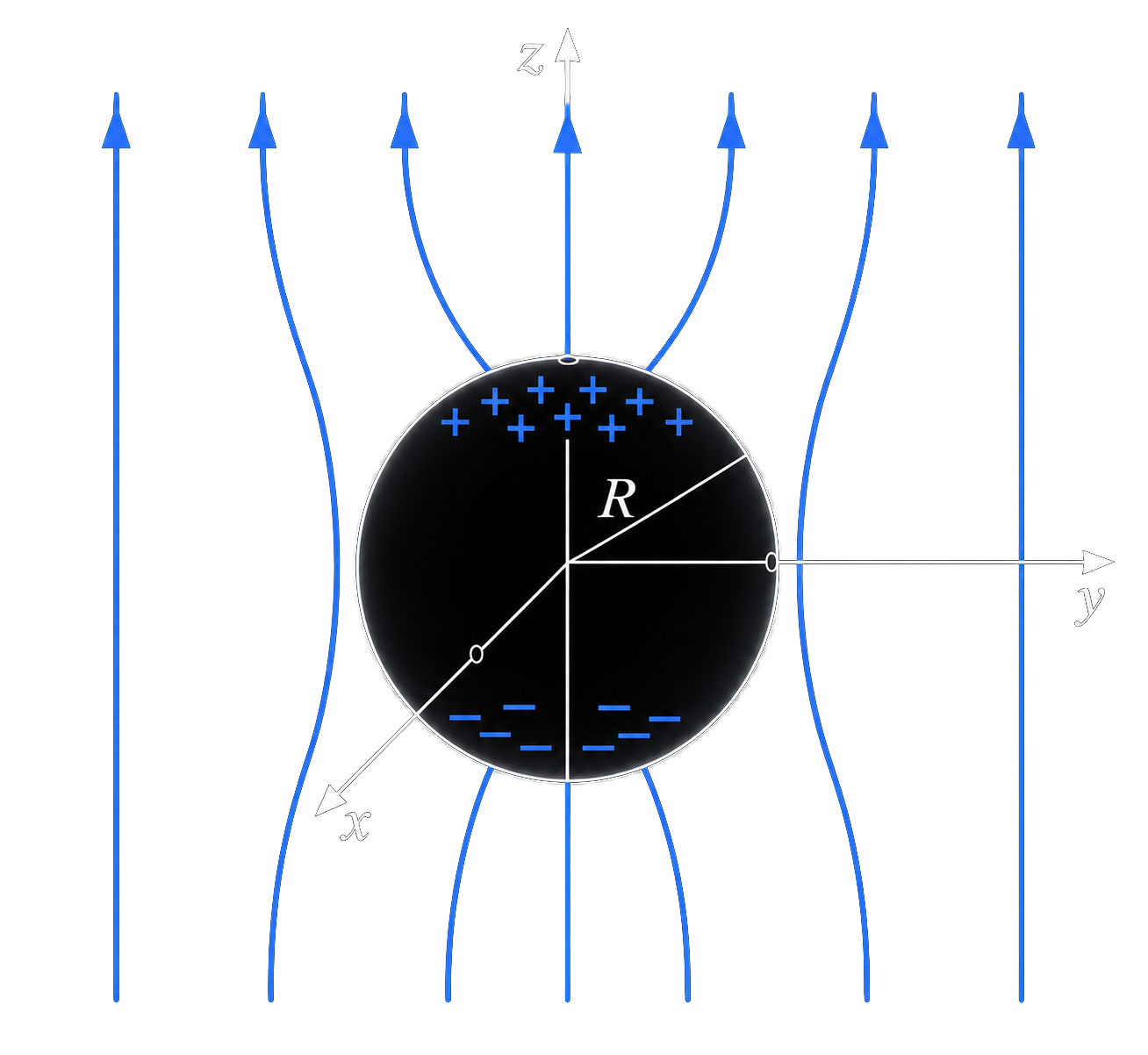
The sphere is an equipotential - we may as well set it to zero. Then, by symmetry, the entire \( xy \)-plane is at potential zero. Far from the sphere, the field is \( E_0\hat{z} \).
$$ \therefore \, V \to -E_0 z + c $$\( V=0 \) in the \( xy \)-plane \( \Rightarrow c=0 \)
Boundary conditions:
i) \( V(R,\theta)=0 \)
ii) \( V\to -E_0r\cos\theta \quad \text{for} \quad r\gg R \)
$$ V(R,\theta)=0 \, \Rightarrow \, A_\ell R^\ell + \frac{B_\ell}{R^{\ell+1}} = 0 $$ $$ \therefore \, B_\ell=-A_\ell R^{2\ell+1} $$ $$ V(r,\theta) = \sum_{\ell=0}^{\infty} A_\ell \left( r^\ell - \frac{R^{2\ell+1}}{r^{\ell+1}} \right) P_\ell(\cos\theta) $$For \( r\gg R \), we have
$$ \sum_{\ell=0}^{\infty} A_\ell r^\ell P_\ell(\cos\theta) = -E_0r\cos\theta $$ $$ \therefore \, A_1=-E_0, \qquad A_\ell=0 \quad \forall \ell\ne1 $$ $$ \therefore \, V(r,\theta) = -E_0 \left( r-\frac{R^3}{r^2} \right) \cos\theta $$The first term is due to the external field.
The contribution due to the induced charge is
$$ \frac{E_0R^3\cos\theta}{r^2} $$The induced surface charge density is related to the electric field immediately outside the conductor. Since the electric field inside a conductor is zero, Gauss's law implies that the normal component of the electric field just outside the surface satisfies
$$ E_\perp=\frac{\sigma}{\varepsilon_0} $$Using \( \vec{E}=-\vec{\nabla}V \), the normal component of the electric field is
$$ E_\perp=-\frac{\partial V}{\partial n} $$where \( n \) denotes the outward normal direction. Therefore
$$ \sigma = -\varepsilon_0 \frac{\partial V}{\partial n} $$For a spherical surface, the outward normal direction is radial, so
$$ \sigma(\theta) = -\varepsilon_0 \left. \frac{\partial V}{\partial r} \right|_{r=R} $$ $$ \sigma(\theta) = \varepsilon_0E_0 \left( 1+\frac{2R^3}{r^3} \right) \cos\theta \Bigg|_{r=R} $$ $$ \sigma(\theta) = 3\varepsilon_0E_0\cos\theta $$eg. A specified charge density \( \color{#00f0ff} \sigma_0(\theta) \) is glued over the surface of a spherical shell of radius \( \color{#00f0ff} R \). Find the resulting potential inside and outside the sphere.
We could do this by direct integration
$$ V = \frac{1}{4\pi\varepsilon_0} \int \frac{\sigma_0}{r} \,da $$but separation of variables is often easier
$$ V(r,\theta) = \sum_{\ell=0}^{\infty} A_\ell \, r^\ell P_\ell(\cos\theta) \qquad r\leq R $$ $$ V(r,\theta) = \sum_{\ell=0}^{\infty} \frac{B_\ell}{r^{\ell+1}} P_\ell(\cos\theta) \qquad r\geq R $$\( V \) is continuous at \( r=R \)
$$ \therefore \, \sum_{\ell=0}^{\infty} A_\ell R^\ell P_\ell(\cos\theta) = \sum_{\ell=0}^{\infty} \frac{B_\ell}{R^{\ell+1}} P_\ell(\cos\theta) $$ $$ \sum_{\ell=0}^{\infty} A_\ell R^\ell \int_0^\pi P_\ell(\cos\theta) P_{\ell'}(\cos\theta) \sin\theta\,d\theta = \sum_{\ell=0}^{\infty} \frac{B_\ell}{R^{\ell+1}} \int_0^\pi P_\ell(\cos\theta) P_{\ell'}(\cos\theta) \sin\theta\,d\theta $$ $$ A_{\ell'}R^{\ell'} = \frac{B_{\ell'}}{R^{\ell'+1}} \, \Rightarrow \, B_\ell=A_\ell R^{2\ell+1} $$A surface charge density produces a discontinuity in the normal component of the electric field. Applying Gauss's law to a thin pillbox that straddles the surface gives
$$ E_{\perp,\text{out}} - E_{\perp,\text{in}} = \frac{\sigma_0(\theta)}{\varepsilon_0} $$Since \( \vec{E}=-\vec{\nabla}V \), this becomes
$$ \left( \frac{\partial V_{\text{out}}}{\partial r} - \frac{\partial V_{\text{in}}}{\partial r} \right)\Bigg|_{r=R} = -\frac{\sigma_0(\theta)}{\varepsilon_0} $$ $$ \left( -\sum_{\ell=0}^{\infty} (\ell+1) \frac{A_\ell R^{2\ell+1}}{r^{\ell+2}} P_\ell(\cos\theta) - \sum_{\ell=0}^{\infty} \ell A_\ell r^{\ell-1} P_\ell(\cos\theta) \right)\Bigg|_{r=R} = -\frac{\sigma_0(\theta)}{\varepsilon_0} $$ $$ \therefore \, \sum_{\ell=0}^{\infty} (2\ell+1) A_\ell R^{\ell-1} P_\ell(\cos\theta) = \frac{\sigma_0(\theta)}{\varepsilon_0} $$ $$ \Rightarrow \, A_\ell = \frac{1}{2\varepsilon_0R^{\ell-1}} \int_0^\pi \sigma_0(\theta) P_\ell(\cos\theta) \sin\theta\,d\theta $$Suppose \( \color{#00f0ff} \sigma_0(\theta)=k\cos\theta \)
$$ \sigma_0(\theta) = k\cos\theta = kP_1(\cos\theta) $$ $$ A_1 = \frac{k}{2\varepsilon_0} \int_0^\pi \left( P_1(\cos\theta) \right)^2 \sin\theta\,d\theta = \frac{k}{3\varepsilon_0} $$ $$ \therefore \, V(r,\theta) = \frac{k}{3\varepsilon_0} r\cos\theta \qquad r\le R $$ $$ V(r,\theta) = \frac{k}{3\varepsilon_0} \frac{R^3}{r^2} \cos\theta \qquad r\ge R $$In particular, if \( \sigma_0(\theta) \) is the induced charge on a metal sphere in an external field \( E_0\hat{z} \), so that \( k=3\varepsilon_0E_0 \), \( V \) inside the sphere is \( E_0r\cos\theta = E_0z \).
$$ \therefore \, \vec{E}_{\text{ind}} = -\vec{\nabla}V_{\text{in}} = -\partial_z(E_0z)\hat{z} = -E_0\hat{z} $$\( \vec{E}=\vec{0} \) inside the sphere (as expected)
Outside the sphere, \( V \) due to this surface charge is
$$ \frac{E_0R^3\cos\theta}{r^2} $$