Resonance in a Series RLC Circuit
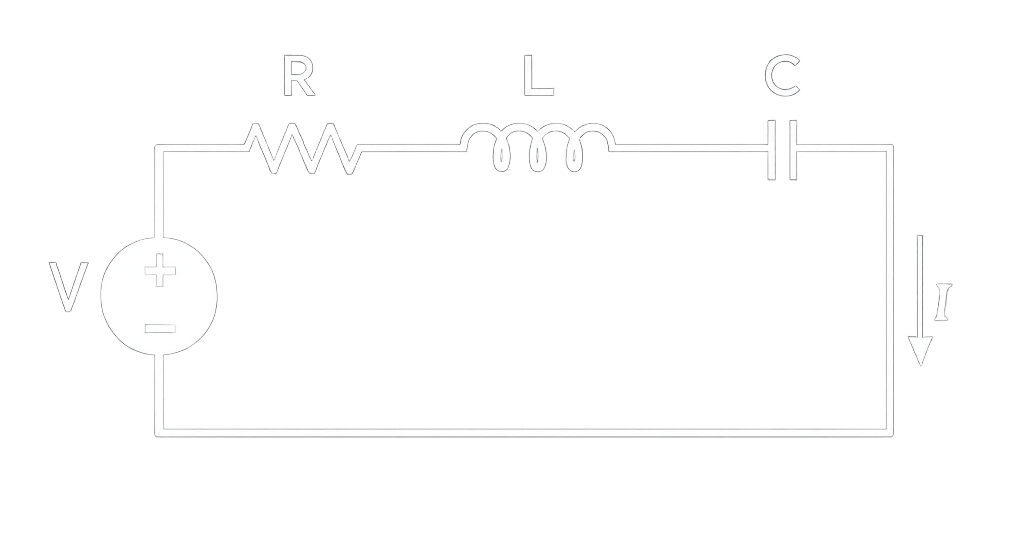
A series RLC circuit consists of a resistor \(R\), inductor \(L\), and capacitor \(C\) connected in series. The charge \(q(t)\) on the capacitor satisfies the differential equation
$$ \frac{d^2 q}{dt^2} + \frac{R}{L}\frac{dq}{dt} + \frac{1}{LC}q = \frac{1}{L}V(t) $$The current in the circuit is given by
$$ I(t) = \frac{dq}{dt} $$When the circuit is driven by a sinusoidal voltage source,
$$ V(t) = V_0 \cos(\omega t) $$two characteristic frequencies appear:
- The driving frequency \( \omega \)
- The natural frequency of the circuit \( \displaystyle \omega_0 = \frac{1}{\sqrt{LC}} \), the frequency at which the circuit naturally oscillates in the absence of driving and damping.
The behaviour of the system depends on the level of damping, which is determined by the resistance \(R\). Three regimes can be identified:
- Underdamped: \( \displaystyle R < 2\sqrt{\frac{L}{C}} \)
- Critically damped: \( \displaystyle R = 2\sqrt{\frac{L}{C}} \)
- Overdamped: \( \displaystyle R > 2\sqrt{\frac{L}{C}} \)
When the circuit is driven by an external voltage, the solution consists of two parts: a transient component, which depends on the initial conditions and decays over time, and a steady-state component, which oscillates at the driving frequency.
Damping controls how the system approaches its steady-state oscillation. The current eventually settles into an oscillation at the driving frequency, but the time taken to reach this steady state depends strongly on the damping:
- Underdamped: the transient response is oscillatory, and the system takes several oscillations to settle into steady-state
- Critically damped: the transient response does not oscillate, and the system reaches steady-state behaviour in the shortest possible time
- Overdamped: the transient response does not oscillate, but it decays slowly and the system approaches steady-state more slowly
In all three cases, the transient response eventually decays, leaving a steady-state oscillation at the driving frequency. The damping determines how quickly this steady-state is reached and whether the transient behaviour is oscillatory.
Resonance occurs when the driving frequency is close to the natural frequency of the circuit, producing a large steady-state response. Damping limits the growth of this response and broadens the resonance peak.
In the notebook below, we solve the RLC circuit equation numerically using solve_ivp(), and explore both the time evolution of the current and its frequency response (resonance).
Open Notebook Environment