Projectile Motion
Consider a soccer ball kicked across level ground at an initial angle \( \theta \). After some time, it returns to the ground at a horizontal distance \( d \) from the launch point. When air resistance is included, the equation of motion is
$$ m \frac{d\vec{v}}{dt} = - m g \hat{y} - k v \vec{v} $$Here \( \vec{v}(t) = (v_x(t), v_y(t)) \) is the velocity of the projectile, and the constant \( k \) characterizes the strength of the quadratic drag force.
In the absence of drag, the only force acting on the projectile is gravity, so the acceleration is
$$ \frac{d^2 x}{dt^2} = 0, \qquad \frac{d^2 y}{dt^2} = -g $$Integrating the vertical equation once gives
$$ \frac{dy}{dt} = -gt + c $$where \(c\) is a constant of integration. To determine \(c\), we use the initial condition: at \(t=0\), the projectile is launched with speed \(v_0\) at an angle \(\theta\), so its vertical velocity is
$$ \left.\frac{dy}{dt}\right|_{t=0} = v_0 \sin\theta $$Therefore \(c = v_0 \sin\theta\), and hence
$$ \frac{dy}{dt} = v_0 \sin\theta - gt $$Integrating once more, and using \(y(0)=0\), gives
$$ y(t) = v_0 t \sin\theta - \frac{1}{2} g t^2 $$A similar argument for the horizontal motion, where the acceleration is zero, gives
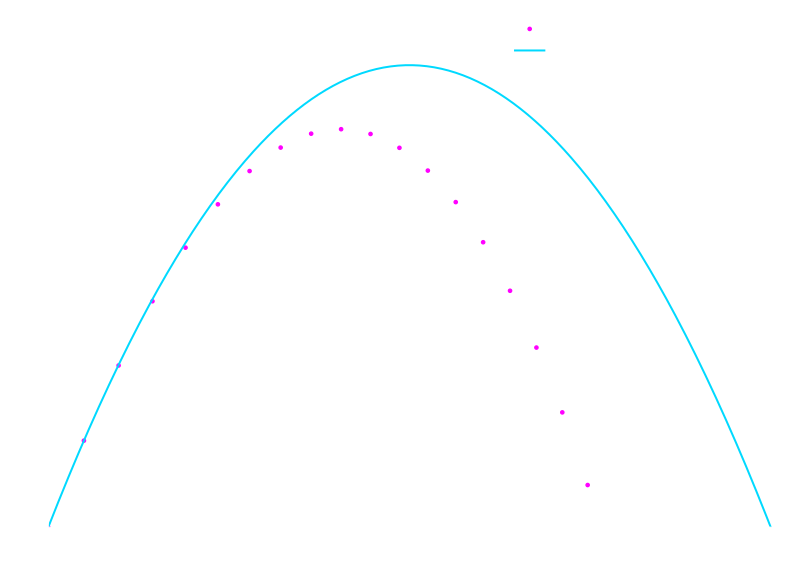
$$ x(t) = v_0 t \cos\theta $$To study the effect of drag, we solve the full equation of motion numerically using solve_ivp(). The numerical trajectory can then be compared directly with the analytical no-drag solution. This makes it possible to isolate and visualize the effect of air resistance on the trajectory. In the implementation below, the solver is used with method = 'LSODA', which adapts efficiently to the behaviour of the system.
The parameters used are:
- \( k = 0.006 \) kg/m
- \( g = 9.81 \) m/s\(^2\)
- \( m = 0.45 \) kg
- \( v_0 = 18 \) m/s
- \( \theta = 40^\circ \)
The resulting trajectories are plotted in the \(x\)-\(y\) plane. The numerical solution is shown as a set of points that are evenly spaced in time, so that the spacing between points reflects the speed of the projectile. The analytical solution is shown as a smooth curve for comparison.
 Open Notebook Environment