Constant Coefficient Linear Second-Order ODEs
Consider the second-order linear homogeneous equation
$$ ay'' + by' + cy = 0 $$together with initial conditions
$$ y(t_0) = y_0, \quad y'(t_0) = y_0' $$As before, we seek two linearly independent solutions \( y_1(t) \) and \( y_2(t) \), so that
$$ y_c(t) = c_1 y_1(t) + c_2 y_2(t) $$gives the general solution.
The key idea is to look for solutions of exponential form. Let \( y(t) = A e^{rt}. \) Then
$$ y' = Ar e^{rt}, \quad y'' = Ar^2 e^{rt} $$Substituting into the differential equation gives
$$ A\left(ar^2 + br + c\right) \, e^{rt} = 0 $$Since \( A \neq 0 \) and \( e^{rt} \neq 0 \), this leads to
$$ ar^2 + br + c = 0 $$This quadratic equation is called the characteristic equation, and its roots determine the form of the solution.
$$ r = \frac{-b \pm \sqrt{b^2 - 4ac}}{2a} $$Two Distinct Roots
If \( b^2 - 4ac > 0, \) then there are two distinct real roots \( r_1 \) and \( r_2 \).
In this case, the corresponding solutions are
$$ y_1(t) = e^{r_1 t}, \quad y_2(t) = e^{r_2 t} $$Their Wronskian is
$$ W(y_1,y_2)(t) = \begin{vmatrix} e^{r_1 t} & e^{r_2 t} \\ r_1 e^{r_1 t} & r_2 e^{r_2 t} \end{vmatrix} $$ $$ = r_2 e^{(r_1+r_2)t} - r_1 e^{(r_1+r_2)t} $$ $$ = (r_2-r_1) \, e^{(r_1+r_2)t} \neq 0 $$since \( r_2 \neq r_1 \). Therefore the solutions are linearly independent, and the general solution is
$$ y_c(t) = c_1 e^{r_1 t} + c_2 e^{r_2 t} $$This corresponds to a combination of two exponential modes, each evolving at its own rate.
eg. Solve the IVP
$$ \color{#00f0ff} y'' + 3y' + 2y = 0, \quad y(0) = 1, \quad y'(0) = -1 $$The characteristic equation is
$$ r^2 + 3r + 2 = 0 $$ $$ (r+2)(r+1) = 0 $$ $$ r_1 = -2, \quad r_2 = -1 $$Hence
$$ y(t) = c_1 e^{-2t} + c_2 e^{-t} $$ $$ y(0) = 1 = c_1 + c_2 $$ $$ c_1 = 1 - c_2 $$Differentiate
$$ y'(t) = -2c_1 e^{-2t} - c_2 e^{-t} $$ $$ y'(0) = -1 = -2c_1 - c_2 $$ $$ -1 = -2(1-c_2) - c_2 $$ $$ \Rightarrow \, c_2 = 1, \quad c_1 = 0 $$ $$ \therefore \, y(t) = e^{-t} $$Repeated Root
If \( b^2 - 4ac = 0, \) then there is a repeated root \( r \).
In this case, a second independent solution is obtained by multiplying by \( t \), giving
$$ y_1(t) = e^{rt}, \quad y_2(t) = t \, e^{rt} $$Their Wronskian is
$$ W(e^{rt},te^{rt})(t) = \begin{vmatrix} e^{rt} & te^{rt} \\ r e^{rt} & e^{rt} + rt e^{rt} \end{vmatrix} $$ $$ = e^{rt}\left(e^{rt} + rt e^{rt}\right) - t e^{rt}\left(r e^{rt}\right) $$ $$ = e^{2rt} \neq 0 $$Therefore these solutions are linearly independent, and the general solution is
$$ y_c(t) = c_1 e^{rt} + c_2 t e^{rt} $$This reflects the fact that a single exponential is not sufficient to span all solutions in the repeated-root case.
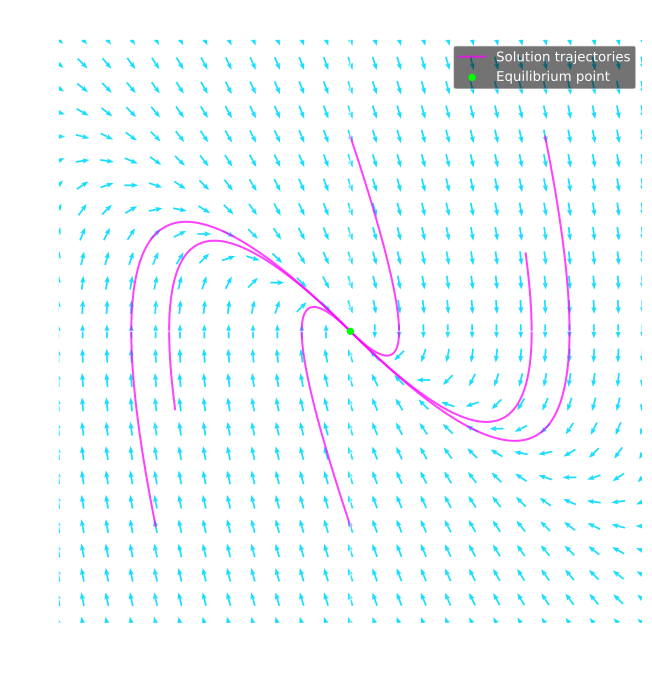
The phase portrait below illustrates the second-order equation \( y'' + 3y' + 2y = 0 \), written as the first-order system \( y' = v, \; v' = -3v - 2y. \) A phase portrait provides a geometric view of the system in phase space, where each point in the \( (y,v) \) plane represents a possible state of the system, with \( y \) denoting the position and \( v=y' \) the velocity. The trajectories show how these states evolve over time, allowing us to visualize the behaviour of entire families of solutions and identify important features such as equilibrium points and stability. In this case, all trajectories approach the equilibrium point \( (y,v)=(0,0) \), reflecting the exponential decay of the solutions.
 See plot code
eg. Solve the IVP
$$ \color{#00f0ff} y'' - 4y' + 4y = 0, \quad y(0) = 2, \quad y'(0) = 0 $$The characteristic equation is
$$ r^2 - 4r + 4 = 0 $$ $$ (r-2)^2 = 0 $$ $$ r = 2 $$Hence
$$ y_1(t) = e^{2t}, \quad y_2(t) = t e^{2t} $$ $$ y(t) = c_1 e^{2t} + c_2 t e^{2t} $$ $$ y(0) = 2 = c_1 $$Differentiate
$$ y'(t) = 2c_1 e^{2t} + c_2 e^{2t} + 2c_2 t e^{2t} $$ $$ y'(0) = 0 = 2c_1 + c_2 $$ $$ \Rightarrow \quad c_2 = -4 $$ $$ \therefore \quad y(t) = 2 e^{2t} - 4t e^{2t} $$Complex Roots
If \( b^2 - 4ac < 0, \) then the roots are complex:
$$ r_1 = \frac{-b + i\sqrt{4ac - b^2}}{2A}, \quad r_2 = \frac{-b - i\sqrt{4ac - b^2}}{2a} $$Write
$$ \lambda = -\frac{b}{2a}, \quad \mu = \frac{\sqrt{4ac - b^2}}{2a} $$so that
$$ r_1 = \lambda + i\mu, \quad r_2 = \lambda - i\mu $$Then the solutions are
$$ e^{(\lambda+i\mu)t}, \quad e^{(\lambda-i\mu)t} $$Using Euler's formula,
$$ e^{(\lambda + i\mu)t} = e^{\lambda t} ( \, \cos(\mu t) + i\sin(\mu t) \, ) $$ $$ e^{(\lambda - i\mu)t} = e^{\lambda t} ( \, \cos(\mu t) - i\sin(\mu t) \, ) $$We do not want complex solutions, so we take linear combinations of these two solutions to obtain real-valued solutions:
$$ y_1(t) = e^{\lambda t}\cos(\mu t), \quad y_2(t) = e^{\lambda t}\sin(\mu t) $$Their Wronskian is
$$ W(y_1,y_2)(t) = \begin{vmatrix} e^{\lambda t}\cos(\mu t) & e^{\lambda t}\sin(\mu t) \\ \lambda e^{\lambda t}\cos(\mu t) - \mu e^{\lambda t}\sin(\mu t) & \lambda e^{\lambda t}\sin(\mu t) + \mu e^{\lambda t}\cos(\mu t) \end{vmatrix} $$Expanding the determinant,
$$ W(y_1,y_2)(t) = e^{\lambda t}\cos(\mu t) \left( \, \lambda e^{\lambda t}\sin(\mu t) + \mu e^{\lambda t}\cos(\mu t) \, \right) - e^{\lambda t}\sin(\mu t) \left( \, \lambda e^{\lambda t}\cos(\mu t) - \mu e^{\lambda t}\sin(\mu t) \, \right) $$which simplifies to
$$ W(y_1,y_2)(t) = \mu e^{2\lambda t} \left( \cos^2(\mu t) + \sin^2(\mu t) \right) = \mu e^{2\lambda t} \neq 0 $$Therefore \( y_1 \) and \( y_2 \) are linearly independent, and so the general solution is
$$ y_c(t) = c_1 y_1(t) + c_2 y_2(t) $$ $$ y_c(t) = c_1 e^{\lambda t}\cos(\mu t) + c_2 e^{\lambda t}\sin(\mu t) $$This corresponds to oscillatory behaviour modulated by exponential growth or decay.
eg. Solve the IVP
$$ \color{#00f0ff} y'' + 2y' + 5y = 0, \quad y(0) = 1, \quad y'(0) = -1 $$The characteristic equation is
$$ r^2 + 2r + 5 = 0 $$ $$ r = \frac{-2 \pm \sqrt{-16}}{2} = -1 \pm 2i $$Hence
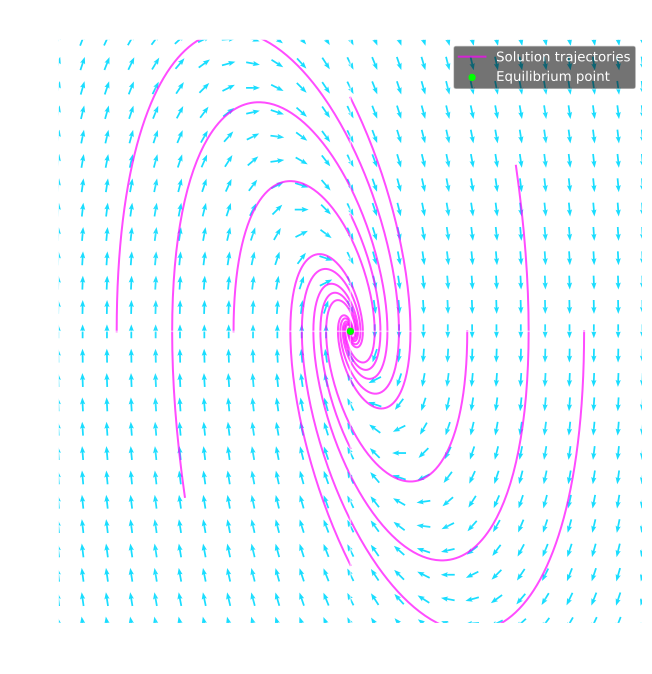
$$ y(t) = c_1 e^{-t}\cos(2t) + c_2 e^{-t}\sin(2t) $$ $$ y(0) = c_1 = 1 $$ $$ y'(0) = -c_1 + 2c_2 = -1 $$ $$ \Rightarrow \, c_2 = 0 $$ $$ \therefore \, y(t) = e^{-t}\cos(2t) $$The phase portrait below illustrates the complex-root equation \( y''+2y'+5y=0 \), written as the first-order system \( y' = v, \, v' = -2v - 5y. \) The characteristic roots are \( r=-1\pm 2i \), so the solutions oscillate while decaying exponentially. In phase space, this appears as trajectories spiraling inward toward the equilibrium point \( (y,v)=(0,0) \):
 See plot code
Euler Equations
Another important class is the Euler equation, where the coefficients depend on powers of \( t \):
$$ at^2\frac{d^2y}{dt^2} + bt\frac{dy}{dt} + cy = 0 $$In this case, we look for solutions of the form \( y(t) = At^n \).
eg.
$$ \color{#00f0ff} 2t^2\frac{d^2y}{dt^2} + 3t\frac{dy}{dt} - 15y = 0, \quad y(1) = 0, \quad y'(1) = 1$$ $$ $$ $$ y(t) = At^n $$ $$ y'(t) = nAt^{n-1} \quad y''(t) = n(n-1)At^{n-2} $$Substituting into the differential equation gives
$$ 2t^2\left(n(n-1)At^{n-2}\right) + 3t\left(nAt^{n-1}\right) - 15At^n = 0 $$ $$ At^n\left(2n^2 - 2n + 3n - 15\right) = 0 $$Since \( At^n \neq 0 \), we must have
$$ 2n^2 + n - 15 = 0 $$ $$ (2n - 5)(n + 3) = 0 $$so
$$ n = \frac{5}{2}, \quad n = -3 $$Therefore two solutions are
$$ y_1(t) = t^{-3}, \quad y_2(t) = t^{5/2} $$Their Wronskian is
$$ W(y_1,y_2)(t) = \begin{vmatrix} t^{-3} & t^{5/2} \\ -3t^{-4} & \frac{5}{2}t^{3/2} \end{vmatrix} $$ $$ = \frac{5}{2}t^{-3/2} + 3t^{-3/2} $$ $$ = \frac{11}{2}t^{-3/2} \ne 0 $$and so \( y_1 \) and \( y_2 \) are linearly independent. Hence the general solution is
$$ y(t) = c_1 t^{-3} + c_2 t^{5/2} $$Differentiate
$$ y'(t) = -3c_1 t^{-4} + \frac{5}{2}c_2 t^{3/2} $$Apply the initial conditions
$$ y(1) = c_1 + c_2 = 0 \quad \Rightarrow \quad c_1 = -c_2 $$ $$ y'(1) = -3c_1 + \frac{5}{2}c_2 = 1 $$ $$ 3c_2 + \frac{5}{2}c_2 = 1 \quad \Rightarrow \quad c_2 = \frac{2}{11}, \quad c_1 = -\frac{2}{11} $$ $$ \therefore \; y(t) = \frac{2}{11} (t^{5/2} - t^{-3}) $$