The Schrödinger Equation
Spherical Harmonics
Moving from one dimension to three dimensions, the wave function now depends on the full position vector \( \vec{r}=(x,y,z) \), with time evolution governed by the Schrödinger equation:
$$ i\hbar\frac{\partial}{\partial t} \, \psi (\vec{r}, t) = \hat{H} \, \psi (\vec{r}, t) $$The Hamiltonian operator comes from the classical expression for the total energy,
$$ \frac{1}{2}mv^2+V = \frac{p^2}{2m} + V $$In three dimensions, each component of momentum becomes a differential operator:
$$ p_x\to -i\hbar\frac{\partial}{\partial x}, \qquad p_y\to -i\hbar\frac{\partial}{\partial y}, \qquad p_z\to -i\hbar\frac{\partial}{\partial z} $$ $$ \hat{\mathbf{p}} = -i\hbar\vec{\nabla} $$Therefore, the three-dimensional time-dependent Schrödinger equation is
$$ i\hbar\frac{\partial}{\partial t} \, \psi (\vec{r}, t) = -\frac{\hbar^2}{2m}\nabla^2 \, \psi (\vec{r}, t) + V \, \psi (\vec{r}, t) $$where
$$ \nabla^2 = \frac{\partial^2}{\partial x^2} + \frac{\partial^2}{\partial y^2} + \frac{\partial^2}{\partial z^2} $$is the Laplacian in Cartesian coordinates.
The probability of finding the particle in an infinitesimal volume element \( d^3r \) is
$$ |\psi(\vec{r},t)|^2 d^3\vec{r} $$where
$$ d^3\vec{r} = dx\,dy\,dz. $$Thus the normalization condition is
$$ \int |\psi|^2 \, d^3\vec{r} = 1 $$with the integral taken over all space.
If the potential is independent of time, the solutions may be separated into spatial and temporal parts:
$$ \psi_n(\vec{r},t) = \psi_n(\vec{r}) e^{-iE_nt/\hbar} $$The spatial wave function then satisfies the time-independent Schrödinger equation:
$$ -\frac{\hbar^2}{2m}\nabla^2 \psi + V \psi = E \psi $$The most general time-dependent solution is a superposition of stationary states:
$$ \psi(\vec{r},t) = \sum_n c_n \psi_n(\vec{r}) e^{-iE_nt/\hbar} $$The constants \( c_n \) are determined by the initial wave function \( \psi(\vec{r},0) \). If the potential permits continuum states, then the discrete sum is replaced, or supplemented, by an integral.
Spherical Coordinates
Many of the most important three-dimensional quantum systems involve central potentials, where the potential depends only on distance from the origin:
$$ V(\vec{r})\to V(r). $$Here it is important to distinguish carefully between the vector \( \vec{r} \) and its magnitude \( r=|\vec{r}| \). The vector specifies a point in space together with its direction, while the scalar \( r \) measures only the distance from the origin.
In problems with spherical symmetry, the potential depends only on \( r \), not on direction. This symmetry is what makes spherical coordinates so powerful in quantum mechanics.
The Schrödinger Equation in Spherical Coordinates
In three dimensions, the natural coordinate system for a spherically symmetric system is spherical coordinates \( (r,\theta,\phi) \). Here \( r \) measures distance from the origin, \( \theta \) is the polar angle measured downward from the positive \( z \)-axis, and \( \phi \) is the azimuthal angle around the \( z \)-axis.
In spherical coordinates, the Laplacian takes the form
$$ \nabla^2 = \frac{1}{r^2}\frac{\partial}{\partial r} \left( r^2\frac{\partial}{\partial r} \right) + \frac{1}{r^2\sin\theta} \frac{\partial}{\partial \theta} \left( \sin\theta \frac{\partial}{\partial \theta} \right) + \frac{1}{r^2\sin^2\theta} \frac{\partial^2}{\partial \phi^2} $$Therefore, the time-independent Schrödinger equation becomes
$$ -\frac{\hbar^2}{2m} \left( \; \frac{1}{r^2}\frac{\partial}{\partial r} \left( r^2\frac{\partial \psi}{\partial r} \right) + \frac{1}{r^2\sin\theta} \frac{\partial}{\partial \theta} \left( \sin\theta \frac{\partial \psi}{\partial \theta} \right) + \frac{1}{r^2\sin^2\theta} \frac{\partial^2 \psi}{\partial \phi^2} \; \right) + V \psi = E \, \psi $$The key simplification comes when the potential depends only on the radial coordinate, \( V = V(r) \). In that case, the system has spherical symmetry, so we look for wave functions that separate into a radial part and an angular part:
$$ \psi(r,\theta,\phi) = R(r) \, Y(\theta,\phi) $$Substituting this into the Schrödinger equation gives
$$ -\frac{\hbar^2}{2m} \left( \; \frac{Y}{r^2}\frac{d}{dr} \left( r^2\frac{dR}{dr} \right) + \frac{R}{r^2\sin\theta} \frac{\partial}{\partial \theta} \left( \sin\theta \frac{\partial Y}{\partial \theta} \right) + \frac{R}{r^2\sin^2\theta} \frac{\partial^2 Y}{\partial \phi^2} \; \right) + VRY = ERY $$Dividing by \( YR \) and multiplying through by \( -2mr^2/\hbar^2 \), we obtain
$$ \frac{1}{R}\frac{d}{dr} \left( r^2\frac{dR}{dr} \right) - \frac{2mr^2}{\hbar^2} \left(V(r)-E\right) + \frac{1}{Y} \left( \frac{1}{\sin\theta} \frac{\partial}{\partial \theta} \left( \sin\theta \frac{\partial Y}{\partial \theta} \right) + \frac{1}{\sin^2\theta} \frac{\partial^2Y}{\partial \phi^2} \right) = 0 $$The first two terms depend only on \( r \), while the last depends only on \( \theta \) and \( \phi \). Since these variables are independent, each part must be constant. We write the separation constant as \( \ell(\ell+1) \) (for reasons that will become clear soon):
$$ \frac{1}{R}\frac{d}{dr} \left( r^2\frac{dR}{dr} \right) - \frac{2mr^2}{\hbar^2} \left(V(r)-E\right) = \ell(\ell+1) $$ $$ \frac{1}{Y} \left( \frac{1}{\sin\theta} \frac{\partial}{\partial \theta} \left( \sin\theta \frac{\partial Y}{\partial \theta} \right) + \frac{1}{\sin^2\theta} \frac{\partial^2Y}{\partial \phi^2} \right) = -\ell(\ell+1) $$The Angular Equation
The angular part of the Schrödinger equation determines the allowed angular structure of the wave function. Multiplying the angular equation by \( Y\sin^2\theta \), we get
$$ \sin\theta \frac{\partial}{\partial \theta} \left( \sin\theta \frac{\partial Y}{\partial \theta} \right) + \frac{\partial^2Y}{\partial \phi^2} = -\ell(\ell+1)\sin^2\theta\,Y $$We now separate the angular function:
$$ Y(\theta,\phi)=\Theta(\theta) \, \Phi(\phi) $$Substituting this into the angular equation and dividing by \( \Theta\Phi \) gives
$$ \frac{1}{\Theta} \left( \sin\theta \frac{d}{d\theta} \left( \sin\theta \frac{d\Theta}{d\theta} \right) \right) + \ell(\ell+1)\sin^2\theta + \frac{1}{\Phi} \frac{d^2\Phi}{d\phi^2} = 0 $$The first two terms depend only on \( \theta \), while the last depends only on \( \phi \). We therefore introduce another separation constant, \( m^2 \):
$$ \frac{1}{\Theta} \left[ \sin\theta \frac{d}{d\theta} \left( \sin\theta \frac{d\Theta}{d\theta} \right) \right] + \ell(\ell+1)\sin^2\theta = m^2 $$ $$ \frac{1}{\Phi} \frac{d^2\Phi}{d\phi^2} = -m^2 $$The \( \phi \)-equation is the simpler one:
$$ \frac{d^2\Phi}{d\phi^2} = -m^2\Phi $$with solutions
$$ \Phi(\phi)=e^{im\phi} $$Since the physical point in space is unchanged when \( \phi \) advances by \( 2\pi \), the angular function must satisfy periodic boundary conditions
$$ \Phi(\phi+2\pi)=\Phi(\phi) $$Therefore,
$$ e^{im(\phi+2\pi)} = e^{im\phi} $$ $$ e^{2\pi im}=1 $$This forces \( m \) to be an integer:
$$ m=0,\pm1,\pm2,\ldots $$The remaining angular equation is
$$ \sin\theta \frac{d}{d\theta} \left( \sin\theta \frac{d\Theta}{d\theta} \right) + \left( \ell(\ell+1)\sin^2\theta - m^2 \right)\Theta = 0 $$Its acceptable solutions are expressed in terms of associated Legendre functions:
$$ \Theta(\theta) = A P_{\ell}^{m}(\cos\theta) $$where
$$ P_{\ell}^{m}(x) = (-1)^m(1-x^2)^{m/2} \left( \frac{d}{dx} \right)^m P_{\ell}(x) $$The functions \( P_{\ell}(x) \) are the Legendre polynomials, defined by Rodrigues' formula:
$$ P_{\ell}(x) = \frac{1}{2^{\ell}\ell!} \left( \frac{d}{dx} \right)^{\ell} (x^2-1)^{\ell} $$For example,
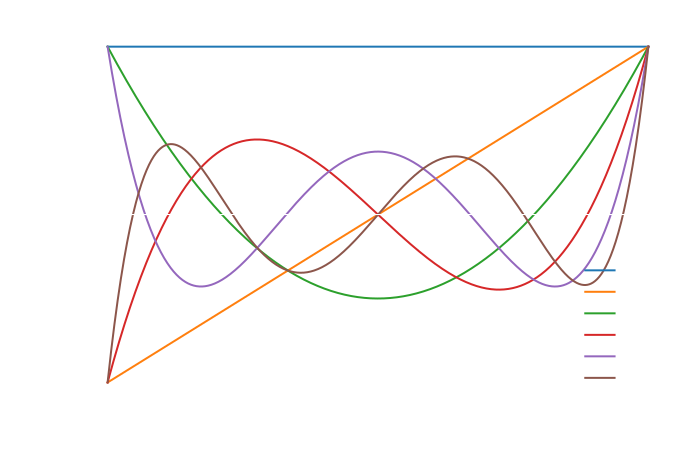
$$ P_0(x)=1, $$ $$ P_1(x) = \frac{1}{2} \frac{d}{dx}(x^2-1) = x, $$ $$ P_2(x) = \frac{1}{4\cdot2} \left( \frac{d}{dx} \right)^2 (x^2-1)^2 = \frac{1}{2}(3x^2-1) $$Several Legendre polynomials are plotted below. Higher-order polynomials exhibit increasingly complex oscillatory structure while remaining orthogonal on the interval \( -1 \le x \le 1 \). This orthogonality makes them particularly useful for expanding angular functions in spherical geometries.
Applying the definition above generates a family of associated Legendre functions for each value of \( \ell \). For \( \ell = 2 \), the first few examples are
$$ P_2^0(x)=\frac{1}{2}(3x^2-1), $$ $$ P_2^1(x) = -(1-x^2)^{1/2} \frac{d}{dx} \left( \frac{1}{2}(3x^2-1) \right) = -3x\sqrt{1-x^2}, $$ $$ P_2^2(x) = (1-x^2) \left( \frac{d}{dx} \right)^2 \left( \frac{1}{2}(3x^2-1) \right) = 3(1-x^2) $$Unlike the Legendre polynomials, the associated Legendre functions depend on both \( \ell \) and \( m \). Increasing \( m \) introduces additional angular structure and changes the number and location of the nodes. The plot below shows the functions \( P_3^m(\cos\theta) \) for several values of \( m \), illustrating how the angular dependence evolves as \( m \) increases.
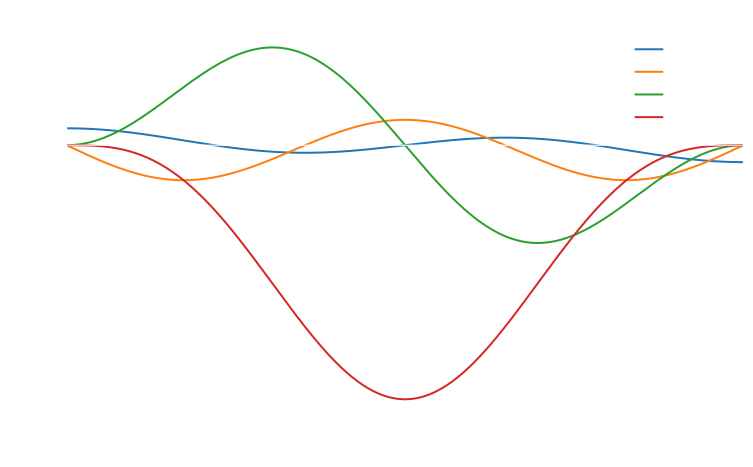
In the angular problem, \( x=\cos\theta \), so the factor \( \sqrt{1-\cos^2\theta} \) becomes \( \sin\theta \). This is why the associated Legendre functions naturally encode the polar-angle dependence of spherical wave functions.
The allowed quantum numbers satisfy
$$ \ell=0,1,2,\ldots \qquad m=-\ell,-\ell+1,\ldots,-1,0,1,\ldots,\ell-1,\ell $$For any given \( \ell \), there are \( 2\ell + 1\) possible values of \( m \). Notice that \( \ell \) must be a non-negative integer for the Rodrigues formula to make any sense. If \( m > \ell \), \( P_{\ell}^{m} = 0 \).
Spherical Harmonics
Combining the \( \theta \)-dependence and the \( \phi \)-dependence gives the spherical harmonics. These functions are the natural angular basis for problems with spherical symmetry:
$$ Y_{\ell}^{m}(\theta,\phi) = \sqrt{ \frac{(2\ell+1)}{4\pi} \frac{(\ell-m)!}{(\ell+m)!} } \; e^{im\phi} \; P_{\ell}^{m}(\cos\theta) $$They satisfy the orthonormality condition
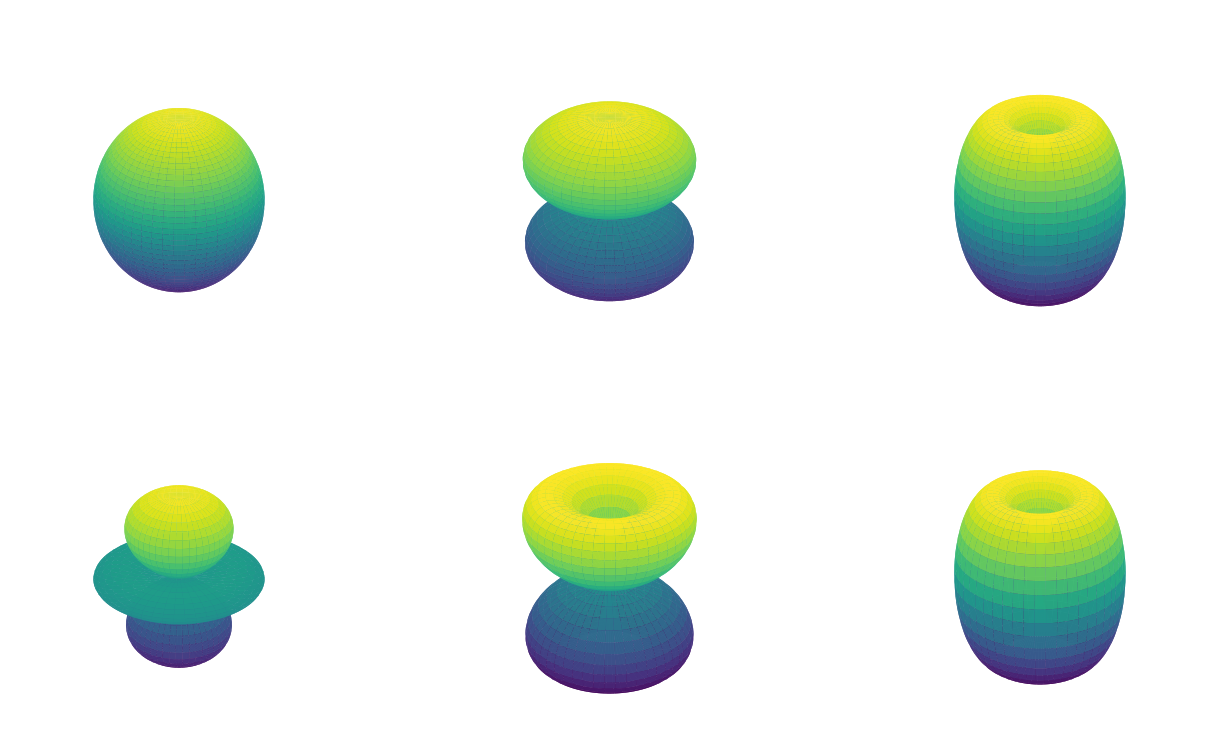
$$ \int_0^{\pi} \int_0^{2\pi} (Y_{\ell}^{m}(\theta,\phi))^* \, Y_{\ell'}^{m'}(\theta,\phi) \, \sin\theta \, d\theta \, d\phi = \delta_{\ell\ell'}\delta_{mm'} $$A spherical harmonic is a function defined on the surface of a sphere. To visualize its angular structure, the magnitude of the function is used to determine the distance from the origin in each direction. This produces a three-dimensional surface whose shape highlights the lobes and nodal regions of the spherical harmonic. The plots below illustrate several examples corresponding to different values of \( \ell \) and \( m \).
 Open Notebook Environment
The normalization condition for the full wave function is
$$ \int |\psi|^2 r^2\sin\theta\,dr\,d\theta\,d\phi = \int |R|^2r^2 \, dr \int |Y|^2 \, \sin\theta \, d\theta \, d\phi = 1 $$It is convenient to normalize the radial and angular parts separately:
$$ \int_0^{\infty}|R|^2r^2\,dr=1 $$ $$ \int_0^{\pi} \int_0^{2\pi} |Y|^2\sin\theta\,d\theta\,d\phi = 1 $$Because the \( \theta \)-equation is second order, it naturally admits two independent solutions, so for any values of \( \ell \) and \( m \), we expect two linearly independent solutions. The associated Legendre functions \( P_{\ell}^{m}(\cos\theta) \) provide only one family of solutions. The missing solutions do in fact exist mathematically, but they are discarded on physical grounds. The second independent solutions become singular at the poles \( \theta = 0 \), \( \theta = \pi \), causing the wavefunction to diverge there. Since physically acceptable quantum-mechanical wavefunctions must remain finite and single-valued everywhere, these singular solutions are excluded.
The Radial Equation
The angular equation is universal for every spherically symmetric potential. The detailed physics of a specific system enters through the radial equation, because the radial part contains \( V(r) \).
$$ \frac{d}{dr} \left( r^2\frac{dR}{dr} \right) - \frac{2mr^2}{\hbar^2} (V(r)-E)R = \ell(\ell+1)R $$A useful substitution is
$$ u(r) = rR(r) $$Then
$$ R=\frac{u}{r} $$ $$ \frac{dR}{dr} = \frac{1}{r} \frac{du}{dr} - \frac{u}{r^2} $$ $$ \frac{d}{dr} \left( r^2\frac{dR}{dr} \right) = r\frac{d^2u}{dr^2} $$The radial equation becomes
$$ -\frac{\hbar^2}{2m} \frac{d^2u}{dr^2} + \left( V + \frac{\hbar^2}{2m} \frac{\ell(\ell+1)}{r^2} \right)u = Eu $$This looks almost exactly like the one-dimensional time-independent Schrödinger equation, except that the effective potential contains an additional angular-momentum barrier:
$$ V_{\text{eff}} = V + \frac{\hbar^2}{2m} \frac{\ell(\ell+1)}{r^2} $$This extra term is often called the centrifugal term. It acts like a repulsive contribution near the origin and reflects the fact that states with nonzero angular momentum resist being concentrated too close to \( r=0 \).
In terms of \( u(r) \), the radial normalization condition is simply
$$ \int_0^{\infty}|u|^2\,dr=1 $$The Infinite Spherical Well
Consider the infinite spherical well potential
$$ V(r) = \begin{cases} \; 0 & r\leq a\\ \infty & r>a \end{cases} $$Outside the well, \( \psi = 0 \). Inside the well, the radial equation is
$$ \frac{d^2u}{dr^2} = \left( \frac{\ell(\ell+1)}{r^2} - k^2 \right)u $$where
$$ k = \frac{\sqrt{2mE}}{\hbar} $$The boundary condition is
$$ u(a)=0 $$For the special case \( \ell=0 \), the equation becomes
$$ \frac{d^2u}{dr^2} = -k^2u $$so
$$ u(r)=A\sin(kr)+B\cos(kr) $$Since \( R(r)=u(r)/r \), the cosine term would make \( R(r) \) blow up like \( 1/r \) near the origin. Therefore \( B=0 \), and we have
$$ u(a) = \sin(ka) = 0 $$Hence
$$ ka=N\pi $$where \( N \) is a positive integer. The allowed energies are therefore
$$ E_{N0} = \frac{N^2\pi^2\hbar^2}{2ma^2} \qquad N=1,2,3,\ldots $$This is the same as for the 1D infinite square well. Normalizing \( u(r) \) gives
$$ u_{N0}(r) = \sqrt{\frac{2}{a}} \sin \left( \frac{N\pi r}{a} \right) $$For arbitrary \( \ell \), the general radial solution is written in terms of spherical Bessel and spherical Neumann functions:
$$ u(r) = A r j_{\ell}(kr) + B r n_{\ell}(kr) $$The spherical Bessel functions and spherical Neumann functions are defined by
$$ j_{\ell}(x) = (-x)^{\ell} \left( \frac{1}{x} \frac{d}{dx} \right)^{\ell} \frac{\sin x}{x} $$ $$ n_{\ell}(x) = -(-x)^{\ell} \left( \frac{1}{x} \frac{d}{dx} \right)^{\ell} \frac{\cos x}{x} $$For example,
$$ j_0(x)=\frac{\sin x}{x}, \qquad n_0(x)=-\frac{\cos x}{x}, $$ $$ j_1(x) = (-x)\frac{1}{x} \frac{d}{dx} \left( \frac{\sin x}{x} \right) = \frac{\sin x}{x^2} - \frac{\cos x}{x}, $$ $$ n_1(x) = -(-x)\frac{1}{x} \frac{d}{dx} \left( \frac{\cos x}{x} \right) = -\frac{\cos x}{x^2} - \frac{\sin x}{x}, $$ $$ j_2(x) = (-x)^2 \left( \frac{1}{x} \frac{d}{dx} \right)^2 \frac{\sin x}{x} = x^2 \left( \frac{1}{x} \frac{d}{dx} \right) \frac{x\cos x-\sin x}{x^3}, $$ $$ j_2(x) = \left( \frac{3}{x^3} - \frac{1}{x} \right)\sin x - \frac{3}{x^2}\cos x $$ $$ n_2(x) = -(-x)^2 \left( \frac{1}{x} \frac{d}{dx} \right)^2 \frac{\cos x}{x} = -x^2 \left( \frac{1}{x} \frac{d}{dx} \right) \frac{-x\sin x-\cos x}{x^3}, $$ $$ n_2(x) = \left( \frac{1}{x} - \frac{3}{x^3} \right)\cos x - \frac{3}{x^2}\sin x $$Near the origin, the spherical Bessel functions remain finite, while the spherical Neumann functions diverge. Thus the physical solution keeps only the spherical Bessel part:
$$ R(r) = A j_{\ell}(kr) $$The boundary condition \( R(a)=0 \) requires
$$ j_{\ell}(ka) = 0 $$Therefore \( ka \) must be a zero of the \( \ell \)-th spherical Bessel function. If \( \beta_{N\ell} \) denotes the \( N \)-th zero of \( j_{\ell} \), then
$$ k = \frac{\beta_{N\ell}}{a} $$The allowed energies are
$$ E_{N\ell} = \frac{\hbar^2}{2ma^2} \beta_{N\ell}^{\,2} $$Although the allowed energies are determined by the pair of quantum numbers \( (N,\ell) \), it is often convenient to introduce the principal quantum number \( n \), which simply labels the energy levels in ascending order, beginning with \( n = 1 \) for the ground state.
Unlike the hydrogen atom, where the energy depends only on \( n \), the spherical well energies generally depend on both the radial quantum number \( N \) and the angular momentum quantum number \( \ell \). So \( n \) is not fundamentally a new mathematical quantity coming from the differential equation. It is more like an overall bookkeeping label for the ordered energy spectrum. The associated wave functions are
$$ \psi_{n\ell m}(r,\theta,\phi) = A_{n\ell} j_{\ell} \left( \beta_{N\ell}\frac{r}{a} \right) Y_{\ell}^{m}(\theta,\phi) $$with \( A_{n\ell} \) determined by normalization. The wave function has \( N-1 \) radial nodes.