Normal Modes on a Unit Disk
Many wave problems are easiest to understand by first finding their normal modes. These are the special spatial patterns that can oscillate independently in time. For a circular disk, polar coordinates are the natural choice, and the relevant spatial eigenvalue problem is
$$ \nabla^2 u = \lambda u $$For the disk modes of interest, the eigenvalues of the Laplacian are negative, so we write
$$ \lambda = -k^2, \quad k > 0 $$Therefore the eigenvalue problem becomes
$$ \nabla^2 u = -k^2 u $$In polar coordinates
$$ \nabla^2 = \frac{1}{r}\frac{\partial}{\partial r} \left( r\frac{\partial}{\partial r} \right) + \frac{1}{r^2}\frac{\partial^2}{\partial \theta^2} $$ $$ \frac{1}{r}\frac{\partial}{\partial r}\left( r\frac{\partial}{\partial r} u(r,\theta) \right) + \frac{1}{r^2}\frac{\partial^2}{\partial \theta^2} u(r,\theta) = - k^2 u(r,\theta) $$Assume a separated solution:
$$ u(r,\theta) = f(r) g(\theta) $$ $$ \frac{1}{f(r)} \frac{1}{r} \frac{\partial}{\partial r} \left(rf'(r)\right) + \frac{1}{r^2}\frac{g''(\theta)}{g(\theta)} = - k^2 $$The left-hand side separates into a function of \( r \) and a function of \( \theta \), so both must equal a constant.
The angular equation is
$$ g''(\theta) = -n^2 g(\theta) \quad g_n(\theta) = e^{in\theta} \quad n \in \mathbb{Z} $$due to periodic boundary conditions (see derivation).
The radial equation is then
$$ \frac{1}{r}\frac{d}{dr} \left( r\frac{df}{dr} \right) - \frac{n^2}{r^2}f = -k^2 f $$ $$ f''(r) + \frac{1}{r}f'(r) + \left( k^2 - \frac{n^2}{r^2} \right)f(r) = 0 $$Now define the dimensionless variable \( z = kr \), and write \( f(r)=Z(z) \). Since \( z=kr \), we have
$$ \frac{df}{dr} = k\frac{dZ}{dz}, \qquad \frac{d^2f}{dr^2} = k^2\frac{d^2Z}{dz^2}. $$Substituting these into the radial equation gives
$$ k^2 Z''(z) + \frac{k}{r}Z'(z) + \left( k^2 - \frac{n^2}{r^2} \right)Z(z) = 0 $$Since \( r=z/k \), this becomes
$$ k^2 Z''(z) + \frac{k^2}{z}Z'(z) + \left( k^2 - \frac{n^2k^2}{z^2} \right)Z(z) = 0 $$ $$ Z''(z) + \frac{1}{z}Z'(z) + \left( 1 - \frac{n^2}{z^2} \right)Z(z) = 0. $$This is Bessel's equation of order \(n\). Therefore the radial part is described by Bessel functions \(J_n(kr)\). For regular solutions at the origin, we keep \(J_n\) and discard the singular Bessel functions of the second kind.
We will be solving this problem with boundary condition \( \partial_r u(1,\theta) = 0 \)
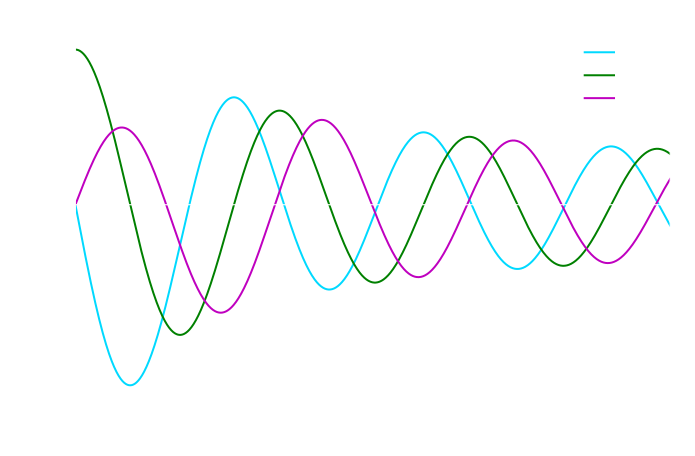
$$ f'(1) = k J_n'(k) = 0 $$For each \( n \), we obtain a discrete set of values for \( k \) by solving \( J_n'(k) = 0 \). The zeros must generally be computed numerically (no closed-form solutions). We denote the solutions by \( k_{n,m} \), where \( m \) labels the \( m \)-th zero of \( J_n'(k) \) and therefore indexes the radial modes, corresponding to increasing radial oscillation.
For \( n = 0 \), there is also a special solution with \( k = 0 \), since \( J_0'(0) = 0 \). This corresponds to a constant mode \( u(r,\theta) = \text{const.} \), which satisfies the free-edge boundary condition and has no spatial oscillation.
The derivative \( J_n'(k) \) determines which wavenumbers are allowed by the free-edge boundary condition.
The corresponding eigenfunctions of \( \nabla^2 \) are
$$ u_{n,m}(r,\theta) = J_n (k_{n,m} r) e^{in\theta} $$with radial part
$$ f_{n,m}(r) = J_n (k_{n,m} r) $$Taking the real part of \( e^{in\theta} \) gives cosine modes
$$ u_{n,m}(r,\theta) = J_n(k_{n,m}r) \cos(n\theta) $$Although the allowed wavenumbers are chosen using the zeros of \( J_n'(k) \), the eigenfunctions themselves are still built from the ordinary Bessel functions \( J_n(k_{n,m}r) \). The derivative appears because of the boundary condition, not because the spatial modes are given by \( J_n' \).
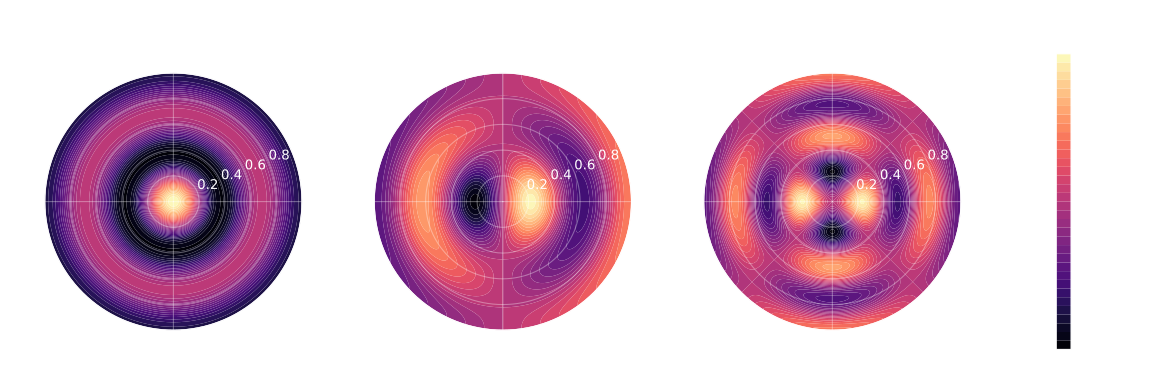
The integer \( n \) controls the angular structure of the mode, while \( m \) indexes the radial oscillations selected by the zeros of \( J_n'(k) \). Compared with the fixed-edge case, these modes need not vanish at the boundary.
These eigenfunctions are the normal modes of vibration of a circular membrane with a free edge. The surface plots below show the displacement of the membrane away from equilibrium, while the nodal lines correspond to regions that remain stationary throughout the motion.
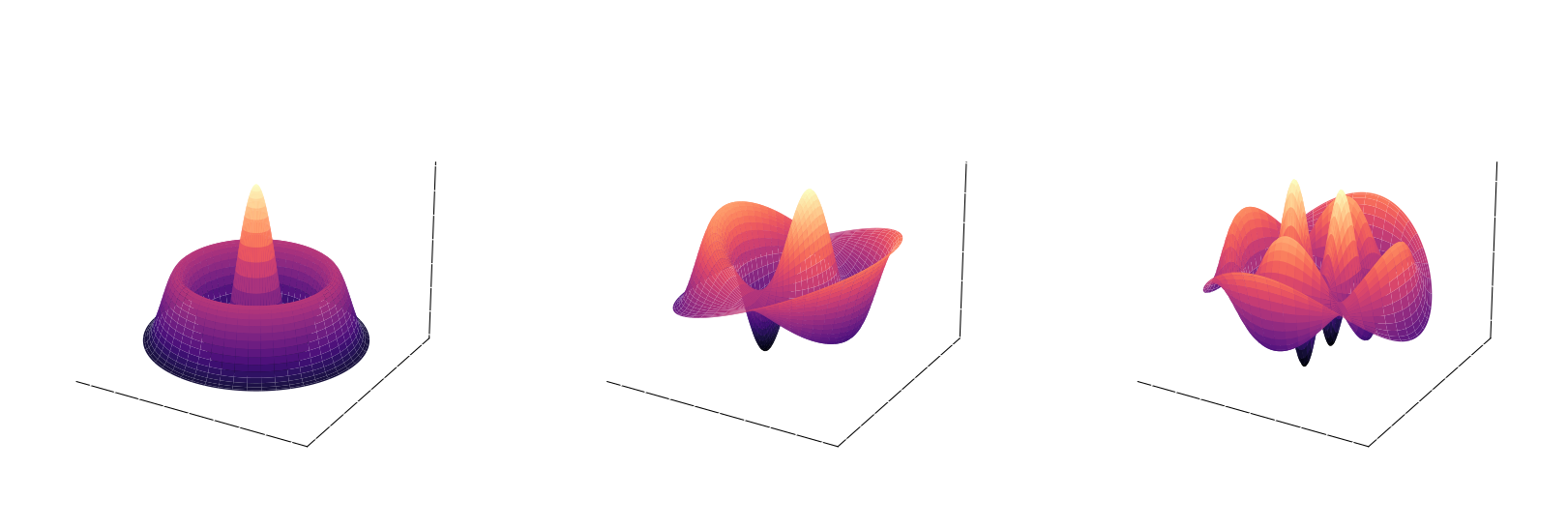
These spatial modes can then be used to construct time-dependent motion on the disk. In the notebook below, we compute the allowed wavenumbers, visualize several Bessel-function modes, examine their orthogonality, and then construct a wave-like solution by superposing modes with different frequencies.
The final part of the notebook shows how an initially localized velocity profile can be expanded in this modal basis. As more modes are included, the solution captures increasingly fine spatial structure, giving a visual demonstration of how eigenfunction expansions represent motion on a circular domain.
Open Notebook EnvironmentTo see a similar problem click here.