The Laplace Equation
The Laplace Equation in Polar Coordinates
Laplace's equation in polar coordinates is
$$ \nabla^2 u(r,\theta) = 0 $$ $$ \frac{1}{r}\frac{\partial}{\partial r}\left( r\frac{\partial}{\partial r} u(r,\theta) \right) + \frac{1}{r^2}\frac{\partial^2}{\partial \theta^2} u(r,\theta) = 0 $$Solutions to Laplace's equation describe equilibrium or steady-state configurations. We will look at the solution for periodic boundary conditions in \( \theta \), \( \, u(r,\theta) = u(r,\theta + 2\pi) \)
$$ u(r,\theta) = f(r)g(\theta) $$ $$ \frac{1}{f(r)} \frac{1}{r} \frac{\partial}{\partial r} \left(rf'(r)\right) + \frac{1}{r^2}\frac{g''(\theta)}{g(\theta)} = 0 $$The left-hand side separates into a function of \( r \) and a function of \( \theta \), so both must equal a constant.
Let
$$ g''(\theta) = \lambda g(\theta) $$This reduces the PDE to separate ordinary differential equations in \( r \) and \( \theta \).
$$ g(\theta) = g(\theta + 2\pi) $$Assume a solution of the form \( g(\theta) = e^{k\theta} \)
$$ k^2 e^{k \theta} = \lambda e^{k \theta} \quad \Rightarrow \quad k^2 = \lambda $$i) \( \lambda > 0 \)
$$ k = \pm \sqrt{\lambda} $$ $$ g(\theta) = c_1 e^{\sqrt{\lambda}\theta} + c_2 e^{-\sqrt{\lambda}\theta} $$ $$ g(\theta + 2\pi) = c_1 e^{\sqrt{\lambda}\theta}e^{2\sqrt{\lambda}\pi} + c_2 e^{-\sqrt{\lambda}\theta}e^{-2\sqrt{\lambda}\pi} $$Therefore, for \( \lambda > 0 \) \( \: g(\theta) \: \) is not periodic, since \( e^{\pm 2\sqrt{\lambda}\pi} \neq 1 \)
ii) \( \lambda = 0 \)
$$ k = 0 \quad \Rightarrow \quad g''(\theta) = 0 $$ $$ \therefore \, g(\theta) = c_1 \theta + c_2 $$ $$ g(\theta + 2\pi) = c_1(\theta + 2\pi) + c_2 $$This is periodic \(\Leftrightarrow \quad c_1 = 0\)
$$ g(\theta) = c_2 $$So \( \lambda = 0 \) corresponds to a constant angular solution.
iii) \( \lambda < 0 \)
$$ k = \pm i\sqrt{-\lambda} \quad |\lambda| = - \lambda $$Let \( \lambda = -b^2 \) where \( b \ge 0 \)
$$ g(\theta) = c_1 e^{i b \theta} + c_2 e^{-i b \theta} $$ $$ g(\theta + 2\pi) = c_1 e^{i b \theta}e^{2i b \pi} + c_2 e^{-i b \theta}e^{-2i b \pi} $$Therefore \( \, g(\theta) = g(\theta + 2\pi) \quad \Leftrightarrow \quad e^{\pm 2i b \pi} = 1 \)
$$ \Rightarrow \quad 2 b \pi = 2\pi n, \quad n = 0, 1, 2, ... $$ $$ b = n, \quad \lambda_n = -b^2 = -n^2 $$Therefore
$$ g_n(\theta) = c_{1,n} e^{in\theta} + c_{2,n} e^{-in\theta} \quad n = 0, 1, 2, ... $$Or equivalently
$$ g_n(\theta) = c_n e^{in\theta} \quad n \in \mathbb{Z} $$Equivalently, using trig functions,
$$ g(\theta) = c_1 \sin(b \theta) + c_2 \cos(b \theta) $$ $$ g(\theta + 2\pi) = c_1 \sin(b (\theta + 2\pi) ) + c_2 \cos(b (\theta + 2\pi) ) $$Therefore \( \, g(\theta) = g(\theta + 2\pi) \quad \Leftrightarrow \quad 2\pi b = 2\pi n \) where \( n = 0, 1, 2, ... \)
$$ \lambda_n = -n^2 $$ $$ g_n(\theta) = c_{1,n} \cos(n\theta) + c_{2,n} \sin(n\theta) $$Negative values of \( n \) do not produce new angular modes since \( \cos(-x) = \cos x \) and \( \sin(-x) = - \sin x \), where the sign can be absorbed into the constants.
The radial equation is then
$$ \frac{1}{r}\frac{f'(r) + rf''(r)}{f(r)} + \frac{\lambda}{r^2} = 0 $$The radial behaviour therefore depends directly on the angular mode number \( n \):
$$ f''(r) + \frac{1}{r}f'(r) - \frac{n^2}{r^2}f(r) = 0 $$This is a Cauchy-Euler equation, so we look for power-law solutions of the form \( f(r) \sim r^p \)
$$ p(p-1) + p - n^2 = 0 $$ $$ (p+n)(p-n) = 0 $$ $$ p = \pm n $$Therefore, for \( n \neq 0 \),
$$ f_n(r) = k_{n,1} r^n + k_{n,2} r^{-n} $$For \( n = 0 \), we need a second linearly independent solution, and the solutions are
$$ r^0 = 1, \quad \ln r $$The general solution is then
$$ u(r,\theta) = a_0 + b_0 \ln r + \sum_{\substack{n=-\infty \\ n\neq 0}}^{\infty} e^{in\theta}\left(a_n r^n + b_n r^{-n}\right) $$Another equivalent form is
$$ u(r,\theta) = a_0 + b_0 \ln r + \sum_{n=1}^{\infty} \left(c_{1,n}\cos(n\theta) + c_{2,n}\sin(n\theta)\right) \left(a_n r^n + b_n r^{-n}\right) $$and yet another equivalent form is
$$ u(r,\theta) = a_0 + b_0 \ln r + \sum_{n=1}^{\infty} \left(c_{1,n} e^{in\theta} + c_{2,n} e^{-in\theta}\right) \left(a_n r^n + b_n r^{-n}\right) $$The solution is therefore built from an infinite superposition of angular Fourier modes and corresponding radial functions.
Laplace Equation on a Disk of Radius 1
Let's solve the Laplace equation on a disk of radius \( 1 \), \( r < 1 \), with boundary condition
$$ u(1,\theta) = \cos(2\theta) $$Using the third form of the general solution, there is another boundary condition implicit in this question: to get a smooth solution inside the disk, we must throw out any terms that blow up as \( r \to 0 \).
Therefore,
$$ u(r,\theta) = a_0 + \sum_{n=1}^{\infty} r^n\left(\alpha_n e^{in\theta} + \beta_n e^{-in\theta}\right) $$ $$ u(1,\theta) = a_0 + \sum_{n=1}^{\infty} \left(\alpha_n e^{in\theta} + \beta_n e^{-in\theta}\right) = \cos(2\theta) = \frac{1}{2}\left(e^{2i\theta} + e^{-2i\theta}\right) $$ $$ \Rightarrow \alpha_2 = \beta_2 = \frac{1}{2} $$ $$ \therefore \, u(r,\theta) = \frac{1}{2}r^2\left(e^{2i\theta} + e^{-2i\theta}\right) = r^2\cos(2\theta) $$Using the first form of the general solution instead,
$$ u(r,\theta) = a_0 + \sum_{\substack{n=-\infty \\ n\neq 0}}^{\infty} e^{in\theta}\left(a_n r^n + b_n r^{-n}\right) $$ $$ u(1,\theta) = a_0 + \sum_{\substack{n=-\infty \\ n\neq 0}}^{\infty} e^{in\theta}(a_n + b_n) = \frac{1}{2}\left(e^{2i\theta} + e^{-2i\theta}\right) $$ $$ a_2 + b_2 = a_{-2} + b_{-2} = \frac{1}{2} $$To satisfy the implicit smoothness condition at \( r=0 \), we must set
$$ b_2 = a_{-2} = 0 $$Therefore,
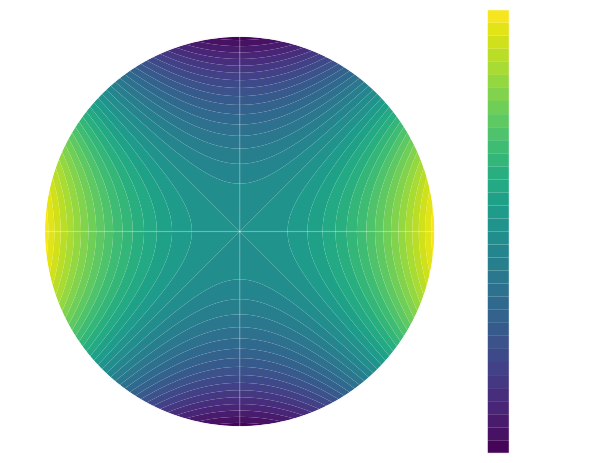
$$ a_2 = b_{-2} = \frac{1}{2} $$ $$ \therefore \, u(r,\theta) = \frac{1}{2}r^2\left(e^{2i\theta} + e^{-2i\theta}\right) = r^2\cos(2\theta) $$The solution forms a quadrupole-like pattern on the disk, with alternating positive and negative regions separated by nodal lines. Below is a polar plot (colour map in polar coordinates) of the solution:
Laplace Equation on an Annulus
Now consider a different region and boundary conditions:
$$ 1 < r < 2 $$ $$ u(1,\theta) = 0 $$ $$ u(2,\theta) = \cos(2\theta) $$Using the first form of the general solution,
$$ u(1,\theta) = a_0 + \sum_{\substack{n=-\infty \\ n\neq 0}}^{\infty} e^{in\theta}(a_n + b_n) = 0 $$ $$ u(2,\theta) = a_0 + b_0 \ln 2 + \sum_{\substack{n=-\infty \\ n\neq 0}}^{\infty} e^{in\theta}\left(a_n 2^n + b_n 2^{-n}\right) = \frac{1}{2}\left(e^{2i\theta} + e^{-2i\theta}\right) $$Because the boundary data only contains the \( n = \pm 2 \) angular modes, only the coefficients with \( n = \pm 2 \) are needed; \( a_{\pm 2} \) and \( b_{\pm 2} \). For these, we have
$$ a_2 + b_2 = 0 $$ $$ a_{-2} + b_{-2} = 0 $$ $$ 4a_2 + \frac{1}{4}b_2 = \frac{1}{2} $$ $$ \frac{1}{4}a_{-2} + 4b_{-2} = \frac{1}{2} $$Since \( b_2 = -a_2, \) we have
$$ 4a_2 + \frac{1}{4}(-a_2) = \frac{1}{2} $$ $$ \frac{15}{4}a_2 = \frac{1}{2} $$ $$ a_2 = \frac{2}{15}, \quad b_2 = -\frac{2}{15} $$Similarly, since \( a_{-2} = -b_{-2}, \) we have
$$ \frac{1}{4}(-b_{-2}) + 4b_{-2} = \frac{1}{2} $$ $$ \frac{15}{4}b_{-2} = \frac{1}{2} $$ $$ b_{-2} = \frac{2}{15}, \quad a_{-2} = -\frac{2}{15} $$Therefore,
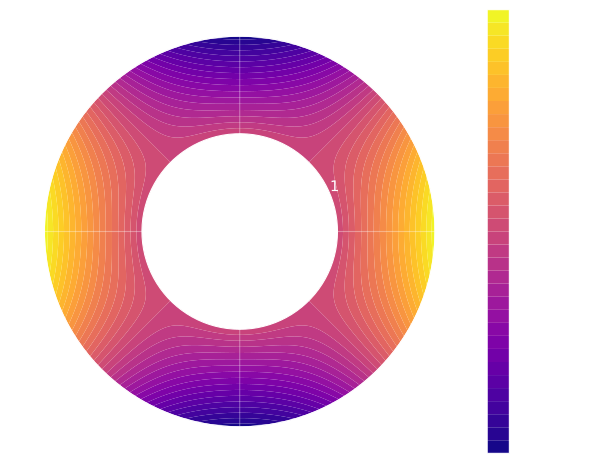
$$ u(r,\theta) = e^{2i\theta}\left(\frac{2}{15}r^2 - \frac{2}{15}r^{-2}\right) + e^{-2i\theta}\left(-\frac{2}{15}r^{-2} + \frac{2}{15}r^2\right) $$ $$ u(r,\theta) = \frac{2}{15}\left(r^2 - \frac{1}{r^2}\right)\left(e^{2i\theta} + e^{-2i\theta}\right) $$ $$ \therefore \, u(r,\theta) = \frac{4}{15}\left(r^2 - \frac{1}{r^2}\right)\cos(2\theta) $$On the annulus, the inner boundary modifies the radial structure of the solution, producing a qualitatively different pattern from the simply connected disk. Below is a polar plot of the solution:
To see the code for the last two plots, click the link below:
Open Notebook EnvironmentTo see a similar problem click here.