Oscillatory Systems
Driven Oscillators and Resonance
In many physical situations, oscillations are not simply left to evolve on their own. Instead, an external force continuously supplies energy to the system. Such systems are called driven or forced oscillators.
Examples include pushing a child on a swing, shaking a building during an earthquake, driving electrical oscillations with an alternating voltage, or forcing a mechanical system to vibrate.
The external source continuously injects energy while damping removes energy. The observed motion is determined by the competition between these two effects.
The equation of motion for a damped driven oscillator is
$$ \ddot{x} + 2\beta \dot{x} + \omega_0^2 x = F(t) $$where \(2\beta\dot{x}\) represents damping and \(F(t)\) is the external driving force.
We will consider a sinusoidal driving force:
$$ F(t)=f_0\cos(\omega t) $$Here:
\(f_0\) is the driving amplitude
\( \omega \) is the angular frequency of the external force
\( \displaystyle \omega_0 = \sqrt{\frac{k}{m}} \) is the natural angular frequency of the oscillator
\( \displaystyle \beta = \frac{\alpha}{2m} \) is the damping parameter
The complete solution consists of two pieces:
$$ x(t)=x_h(t)+x_p(t) $$where \(x_h(t)\) is the homogeneous solution and \(x_p(t)\) is a particular solution generated by the external source.
Finding the Particular Solution
Instead of solving directly with sine and cosine functions, complex notation makes the mathematics much cleaner.
Replace the real driving force with \( f_0 e^{i\omega t} \)
$$ \ddot{z} + 2\beta \dot{z} + \omega_0^2 z = f_0 e^{i\omega t} $$and search for a solution of the form
$$ z(t) = c e^{i\omega t} $$Differentiating gives
$$ \dot{z}(t) = i\omega c e^{i\omega t} $$ $$ \ddot{z}(t) = -\omega^2 c e^{i\omega t} $$Substituting into the differential equation:
$$ -\omega^2c + 2i\beta\omega c + \omega_0^2c = f_0 $$Solving for \(c\),
$$ c= \frac{f_0} { \omega_0^2-\omega^2+2i\beta\omega } $$Since the physical displacement must be real, we write
$$ c = A e^{-i\delta} $$which gives the real solution
$$ x(t) = A\cos(\omega t-\delta) $$where \(A\) is the oscillation amplitude and \(\delta\) is the phase difference between the external force and the oscillator response.
Amplitude and Phase
After some algebra we obtain:
$$ A^2= \frac{f_0^2} { (\omega_0^2-\omega^2)^2 + 4\beta^2\omega^2 } $$or equivalently
$$ A= \frac{f_0} { \sqrt{ (\omega_0^2-\omega^2)^2 + 4\beta^2\omega^2 } } $$The phase shift satisfies
$$ \delta= \tan^{-1} \left( \frac{2\beta\omega} {\omega_0^2-\omega^2} \right) $$The full solution therefore becomes
$$ x(t) = A\cos(\omega t-\delta) + c_1 e^{r_+t} + c_2 e^{r_-t} $$The first term is the forced response (particular solution of the inhomogeneous equation), while the last two terms are the transient terms inherited from the damped oscillator (general solution of the homogeneous equation).
Recall that for damped systems the homogeneous terms decay exponentially:
$$ c_1 e^{r_+t} + c_2 e^{r_-t} \rightarrow 0 \quad \text{as} \quad t\rightarrow\infty $$Therefore after sufficient time has passed, the oscillator forgets its initial conditions and settles into a steady-state motion:
$$ x(t) = A\cos(\omega t-\delta) $$The transient contribution disappears because damping removes the energy associated with the initial conditions.
Resonance
Resonance occurs when energy is transferred into the system at nearly the same rhythm as its natural motion. Each push arrives at exactly the right moment, allowing the oscillation to grow larger and larger.
Famous examples include soldiers breaking step while crossing bridges, buildings responding to earthquake frequencies, tuning radio circuits, and the vibration of molecules under electromagnetic radiation.
Engineers intentionally add damping mechanisms because increasing damping reduces the resonance peak and prevents destructive oscillations.
The angular frequency of the driven force is a quantity that an experimenter can change. How does \(A\) depend on \( \omega \)?
$$ A(\omega) = \frac{f_0} { \sqrt{ (\omega_0^2-\omega^2)^2 + 4\beta^2\omega^2 } } $$We see that
$$ A(\omega)\rightarrow 0 \; \text{as} \; \omega\rightarrow\infty $$and
$$ A(\omega) \rightarrow \frac{f_0}{\omega_0^2} \; \text{as} \; \omega\rightarrow 0 $$\(A(\omega)\) is maximum when \( \displaystyle \frac{dA(\omega)}{d\omega}=0 \)
$$ \frac{dA(\omega)}{d\omega} = -\frac12 f_0 \frac{ 2(\omega_0^2-\omega^2)(-2\omega) + 8\beta^2\omega } { \Big( (\omega_0^2-\omega^2)^2 + 4\beta^2\omega^2 \Big)^{3/2} } $$This becomes zero when
$$ -4(\omega_0^2-\omega^2) + 8\beta^2 = 0 $$i.e.
$$ \omega^2 = \omega_0^2 - 2\beta^2 $$There is a maximum only when
$$ \omega_0^2 - 2\beta^2 > 0 $$i.e.
$$ \omega_0 > \sqrt{2}\beta $$or
$$ \beta < 0.707\,\omega_0 $$Physically, this means that too much damping (high \( \beta \)) will kill the resonance. When \( \beta \) becomes very small, the resonance amplitude can become arbitrarily large. Even infinite when \( \beta=0 \).
A critical or overdamped oscillator, \( \beta\geq\omega_0 \), cannot enter resonance.
By replacing \( \omega \) with
$$ \omega = \omega_0 \sqrt{ 1 - 2 \left( \frac{\beta}{\omega_0} \right)^2 } $$in \(A(\omega)\), we get the maximum amplitude at resonance:
$$ A = \frac{f_0} { \sqrt{ (\omega_0^2-\omega^2)^2 + 4\beta^2\omega^2 } } $$ $$ A_{\max} = \frac{f_0} { \sqrt{ \left( \omega_0^2 - \omega_0^2 \left( 1 - 2 \left( \beta / \omega_0 \right)^2 \right) \right)^2 + 4\beta^2\omega_0^2 \left( 1 - 2 \left( \beta / \omega_0 \right)^2 \right) } } $$ $$ = \frac{f_0} { \sqrt{ 4\beta^4 + 4\beta^2\omega_0^2 - 8\beta^4 } } = \frac{f_0} { \sqrt{ 4\beta^2\omega_0^2 - 4\beta^4 } } $$ $$ A_{\max} = \frac{f_0} { 2\beta\omega_0 \sqrt{ 1 - \left( \beta / \omega_0 \right)^2 } } $$Earthquakes are examples of forced oscillations. In order to avoid building destruction we add damping systems that change the building frequency so that it does not enter resonance.
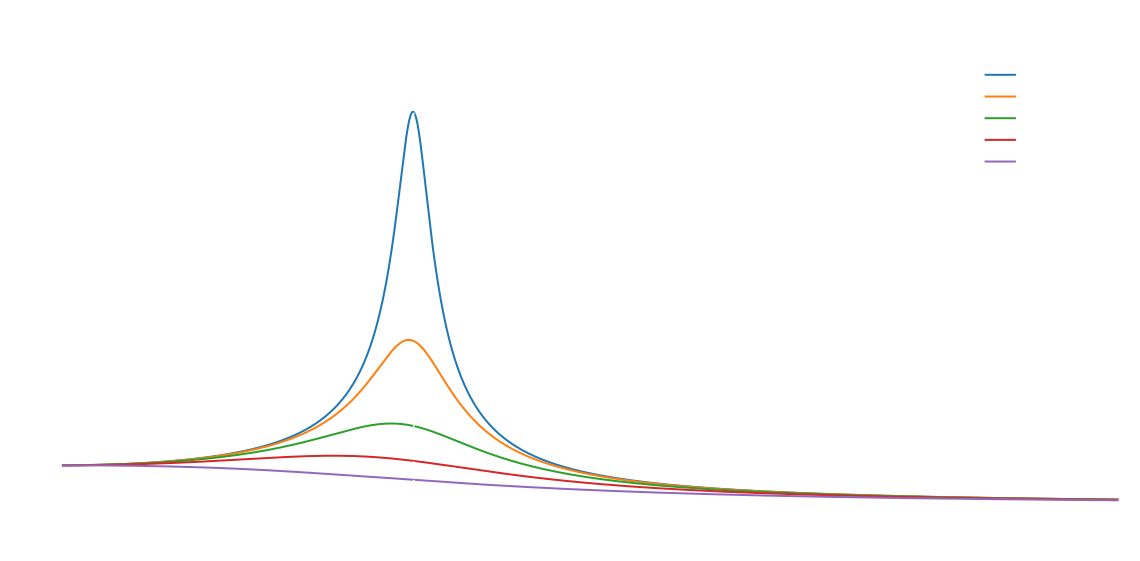 See plot code